

5 Books to Explore the Shadow
In dreams, alchemy, fairy tales & inner work

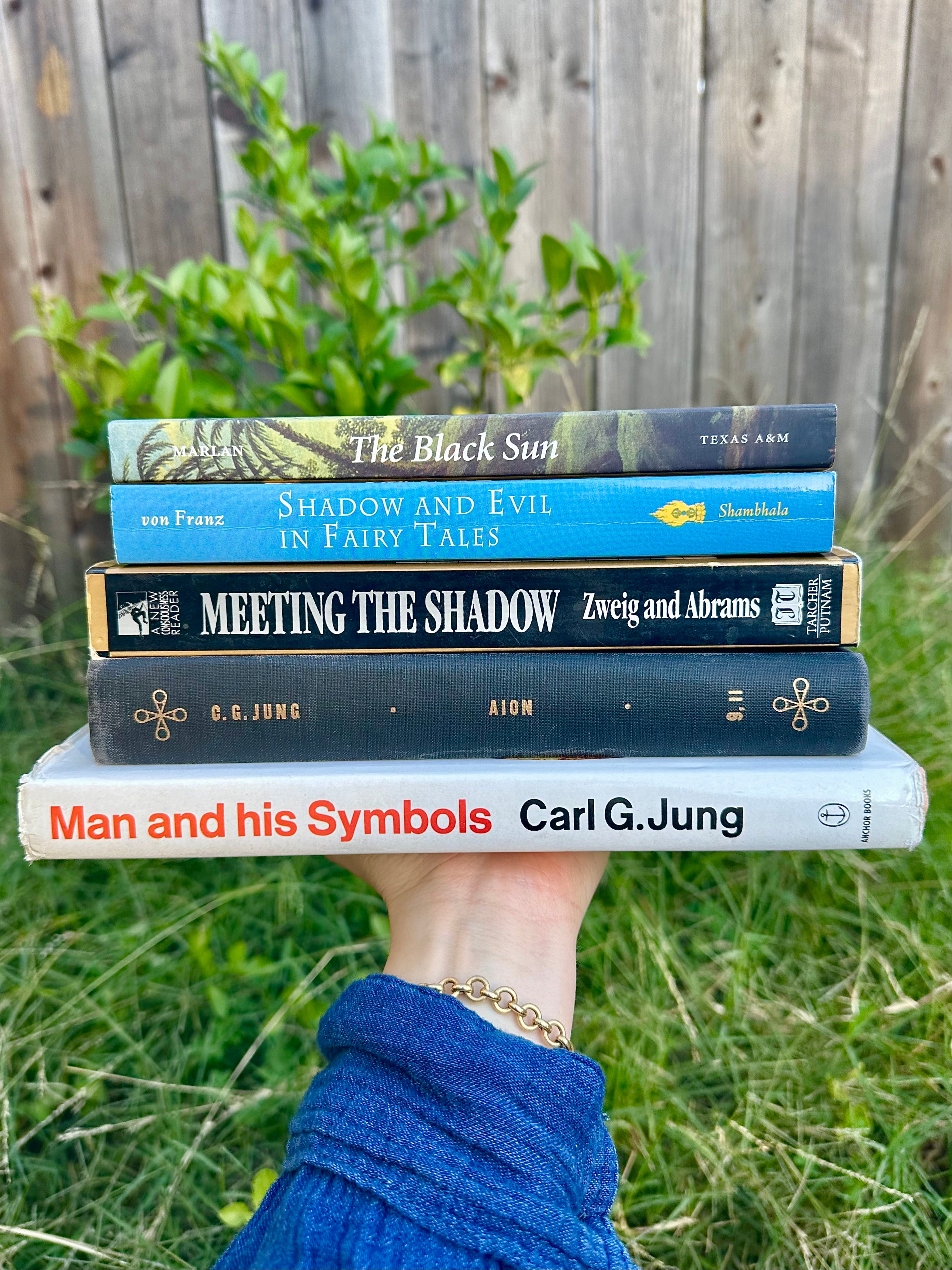
The shadow is an elusive and mercurial force of the psyche. By its nature (hidden, repressed, contradictory, banished) it is difficult to grasp and bring into the light of conscious awareness. In recent years, the idea of shadow work has become popularized, and with its rise in interest, misconceptions have flourished. Often, the complexity of the shadow is reduced to unfavorable traits, or to a vague sense of evil, or the idea that our shadow can be full integrated, and thus, eliminated.
In actuality, the shadow is a rich and vast realm of the psyche, containing both positive and negative aspects that we have denied, been forced to shun, or simply never realized. Self-confidence is just as likely relegated to shadow as is the tendency towards being judgmental or cruel.
The shadow can be personal (from repressed traumas to powerful complexes that drive unconscious behavior), collective (such as shared cultural projections or familial tendencies to deny certain qualities), and archetypal (the chthonic, underworld aspects woven into the collective unconscious and all archetypes).
Meeting the shadow requires humility, for we will often deny, turn away or refuse its presence at all cost. If the tension can be held, however, the shadow becomes a source of life-giving renewal, strengthening the ego and and cultivating self-acceptance.
“It is a therapeutic necessity, indeed, the first requisite of any thorough psychological method, for consciousness to confront its shadow.”
— C.G. Jung, Mysterium Coniunctionis (CW 14)
It is no easy task, and oftentimes, approaching it from the personal layer is nothing short of overwhelming. The below recommendations provide a variety of ways to come to know shadow: from paths of inner work to archetypal expressions in dreams, alchemy and fairy tales. Further, I’ve drawn upon books from a wide range of Jungian inspired authors, as well as options to read Jung’s own words on the shadow.
Although not exhaustive, my hope is this list inspires a deeper curiosity on the shadow and its many faces. If you have a favorite book on the shadow, I’d love to hear about it (join me in the comments!).
#1 — Aion (Chapter II, “The Shadow”, CW 9.2) by C.G. Jung


“The shadow is a moral problem that challenges the whole ego-personality, for no one can become conscious of the shadow without considerable moral effort. To become conscious of It involves recognizing the dark aspects of the personality as present and real. This act is the essential condition for any kind of self-knowledge, and it therefore, as a rule, meets with considerable resistance. Indeed, self-knowledge as a psychotherapeutic measure frequently requires much painstaking work extending over a long period.”
—C.G. Jung, Aion (CW 9.2)
Aion is a complex exploration of the Self, the archetype of wholeness that sits at the center of the psyche. The book is Jung’s attempt to trace the patterns and emanations of the archetype through symbolic and archetypal expressions found in religion alchemy, astrology, and more.
This is not a beginner’s text, for written late in Jung’s life, it weighs heavy with complicated research and the tenuous weaving of such a rich topic. After completing the main portion of the book, however, Jung was tasked to add supplemental chapters to clarify key terminology and archetypes he referred to throughout his writing. Chapter II, “The Shadow”, is a short but punchy explanation. Although Jung refers to the shadow through out much of the Collected Works, it here in Aion that we are provided with a concise and contained description, a great resource to read Jung’s own words on the subject.
#2 — Man and His Symbols (“The realization of the shadow”) by Marie-Louise von Franz


“Whether the unconscious appears at first in a helpful or a negative form, over time there usually arises a need to readapt the conscious attitude in a better way to the unconscious factors — to accept what may seem like “criticism” from the unconscious. Through dreams, one becomes acquainted with aspects of one’s own personality that, for various reasons, one has preferred not to examine too closely. This is what Jung called “the realization of the shadow.” (He used the term “shadow” for this unconscious part of the personality because it often appears in dreams in a personified form.)”
—Marie Louise von Franz, Man and His Symbols
Created in the final years of Jung’s life, Man and His Symbols is a collaborative work aimed at introducing core Jungian concepts to the general public. While Jung wrote the first section, all other parts of were authored by close colleagues, including Marie-Louise von Franz, Joseph L. Henderson, Jolande Jacobi, and Aniela Jaffé.
Jungian analyst Marie-Louise von Franz is arguably one of Jung’s most prolific students and collaborators. As soror mystica and intellectual partner, she began her work with him at just 19 years-old, translating ancient Greek and Latin texts as Jung began a deep dive into alchemy. Her scholarship and teaching takes the heart of Jungian psychology, which is often dense and technical, and delivers it with clarity, precession and accessibility.
Head over to part 3 of the book, and then to the section titled “The realization of the shadow,” for a clear and practical explanation of uncovering shadow. Here, von Franz pays special attention to dreams — one of the key sources of the unconscious that we mine for shadow material.
Although the shadow in dreams takes many forms, von Franz emphasizes how we can find insight in the attributes of dream figures. From those with a dignified air or an intense introversion, we can begin to unpack the qualities, impulses, and emotions that the ego has rejected or cast aside, revealing essential aspects of the personality that must be acknowledged and integrated for genuine psychological development.
#3 — Meeting the Shadow edited by Connie Zweig and Jeremiah Abrams


“Everything with substance casts a shadow. The ego stands as light to shade. This is the quality that makes us human. Much as we would like to deny it, we are imperfect. And perhaps it is in what we don’t accept about ourselves—our aggression and shame, our guilt and pain—that we discover our humanity.”
— from the editor’s introduction of Meeting the Shadow
Meeting the Shadow was one of the first books I purchased in my early days of research and study. The anthology brings together essays from Jung, Ken Wilber, James Hillman, Christine Downing, Robert Bly, and many others.
Perhaps its most useful feature is that it is broken down into ten parts, with themes ranging from the shadow in family dynamics, the body and sexuality, religion and spirituality, evil, and more. For that reason, it has never been a book I’ve read chronologically. Sometimes, I browse the table of contents, searching for a specific subject. Other times, with a flourish of the diviner’s whimsy, I open to a random page as an act of bibliomancy, reflecting on the words and how these elements of shadow are currently present.
I also appreciate the more practical and grounded sections, offering ways to work with the shadow via ritual, dreams, art, etc. It’s a wonderful inner work companion for those deepening their journey.
#4 — Shadow and Evil in Fairy Tales by Marie Louise von Franz


“In Jungian psychology, we generally define the shadow as the personification of certain aspects of the unconscious personality, which could be added to the ego complex but which, for various reasons, are not. We might therefore say that the shadow is the dark, unlived, and repressed side of the ego complex, but this is only partly true. Jung, who hated it when his pupils were too literal-minded and clung to his concepts and made a system out of them and quoted him without knowing exactly what they were saying, once in a discussion threw all this over and said, “This is all nonsense! The shadow is simply the whole unconscious.’”
— Marie Louise von Franz, Shadow and Evil in Fairy Tales
Up until this point, many of the defining ideas regarding the shadow have focused on its relation to the ego, the shadow as the unlived side of the personality. When I first read Shadow and Evil in Fairy Tales, and the opening quote noted above, I was completely floored.
The shadow as the entirety of the unconscious?! Perhaps this idea was hinted at in other books, but never had it been so clearly (and challengingly) stated. From that time, I have strived to temper and broaden my scope of shadow, reminding myself that it is present when I dip into any area of the unconscious, when I engage archetypal material of all sorts.
Marie-Louise von Franz brings us into the mythic landscape, detailing how fairy tales depict shadow in its heroes and heroines, environments, subtle patterns and symbols. My particular favorite is her analysis on Vasilisa the Beautiful, where shadow emerges in the heroine’s disconnection and loss of her mother, the evil ways of her step-family, the chthonic power of the Baba Yaga and more.
#5 — The Black Sun by Stanton Marlan


“The black sun is a paradox. It is blacker than black, but it also shines with a dark luminescence that opens the way to some of the most numinous aspects of psychic life. It proffers a miracle of perception at the heart of what Jung called the mysterium coniunctionis.”
— Stanton Marlan, The Black Sun
Following the archetypal thread, we now turn to Stanton Marlan’s The Black Sun. While not explicitly a book on shadow, the alchemical image of the black sun captures the paradoxical nature of our own psychodynamics. The symbol is most often found in reference to the nigredo, the initial stage of blackening where the prima materia is reduced to ashes, dissolved and destroyed, so that its old form may die and make way for renewal.
Within this darkness, alchemy tells us, is a new kind of illumination, a sun that shines with black rays. In relation to the shadow, the black sun reminds us that overwhelm, disorientation, repulsion, wounding (or whatever else the shadow brings) holds keys to transformative potential. This is sometimes referred to as the golden shadow1, the hidden light and seeds of vitality that sit at the heart of what has been rejected, ignored or denied.
Marlan lays out a beautiful and nuanced exploration of the black sun, showing its influence and presence across clinical experience, art, poetry, literature and more. Although profoundly archetypal (which is to say vastly universal and quite numinous in feel), the alchemical backdrop somehow helped me build a deeper, more personal relationship to shadow. I hope it does the same for you.
Shadow resources at The Artemisian:
Workshops
Articles
Resource Library
Join the conversation
What’s your favorite book on the shadow? Have you read any of the books on this list? Which subject/book recommendations should I cover next — let me know your thoughts!
The concept inspired my podcast of the same name :)
There are so many gems in your substack alone Alyssa - this is enough for my initial digestion. It makes sense also in relation to Dr Bernardo Kastrup’s theory re. Consciousness and analytical idealism which I have been exploring recently 🙏
Which one is your favorite? I'm familiar with the man and his symbols and meeting the shadow. Both came across as pretty dense when I first tried them. Have you found any jungian work about shadow, dreams, and symbols that feels pretty approachable and easy to read?