

4 Tarot Books to Begin Your Studies
From a Jungian, archetypal, and psychological perspective

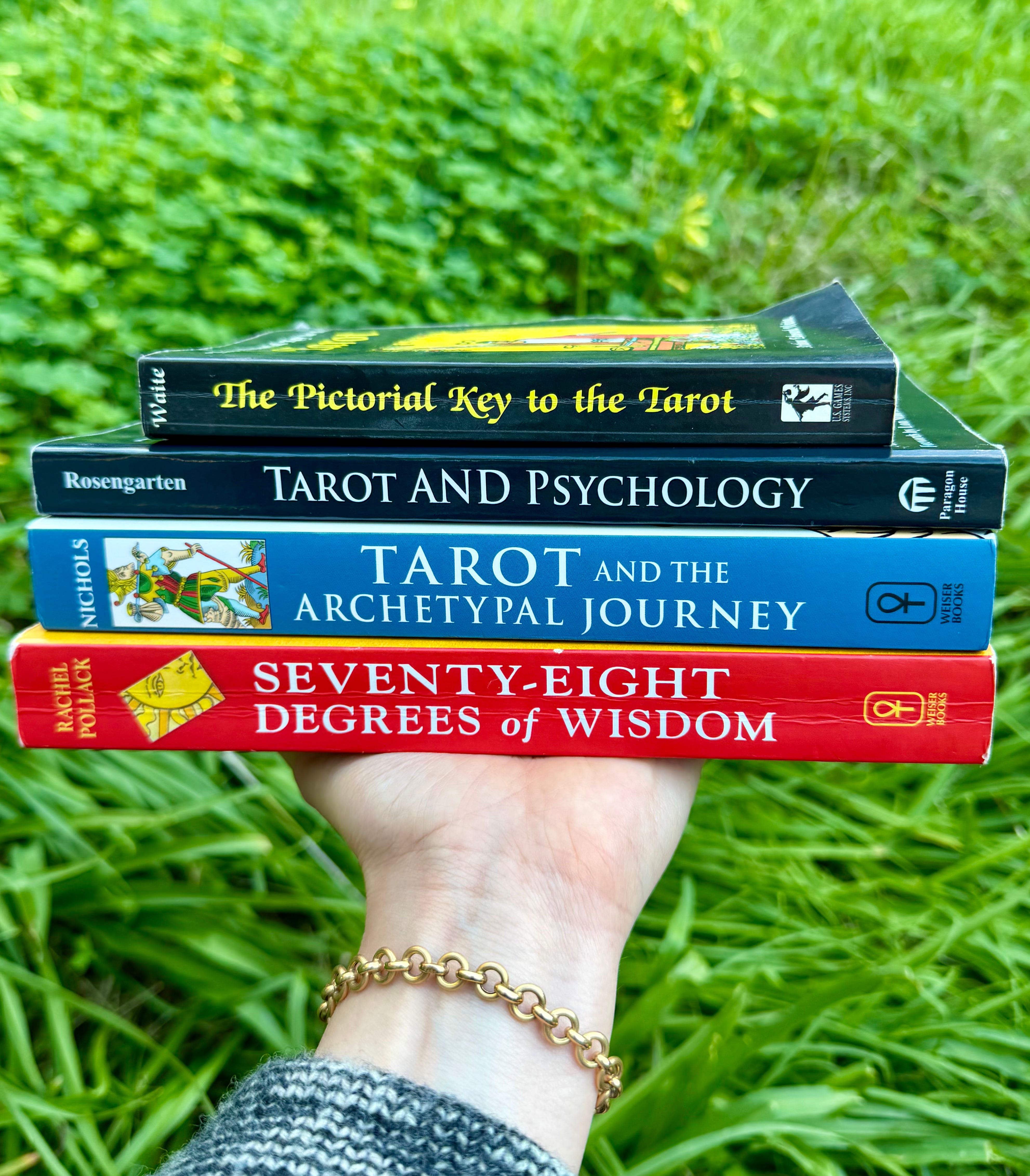
Over a decade ago, after many run ins with the tarot, I began to use and study it much more seriously. It began simply at first. My friends and I would find ourselves gathered over a meal, sipping tea or casually hanging out. I would pull out the cards and we’d each draw one at random, commenting on the strange symbols and potential meanings. Without fail, each one of us felt that the card drawn spoke uncannily to the current moment of our lives, or that it offered a pathway through what felt intractable.
Though I had been steeped in psychospiritual studies and forms of inner work, the tarot captured my imagination like no other system had. It truly broke open an archetypal gateway that had been building in my unconscious. I was so drawn to the cards, near possessed with intensity and enthusiasm, that I would sit learning the ins and outs of them for hours upon end. I’d recite meanings and card progressions while hiking, started pointing out “tarot” moments in daily life and even began dreaming of the cards.
From there, I began hosting community tarot circles, teaching in-depth classes and lecturing at various venues. It became the foundations of the very work I do today, schooling me in the art of symbolism, which has since broadened into other archetypal systems like alchemy, mythology and dreams. In the quiet moments of the everyday, I still turn towards the tarot for inner work support. Sometimes, all I do is pull a card and sit with the image or use it to inspire my journaling or seed a dream.
In many ways, tarot feels like my archetypal home, the place where my intuition springs forth with incredible ease and the symbols whisper their intrigue and mysteries. In the years I’ve worked with the cards, I’ve only grown more fascinated by the way they continue to shape-shift and take new form. For those curious to engage in archetypal inner work, the tarot is an accessible and exciting place to start.
Though the list of influential books I’ve found on this journey is much longer, the following ones provide a path towards my particular use of the cards—a Jungian, archetypal and psychological approach—while remaining fairly beginner friendly.
Alright, let’s dive in!
#1 — Seventy-Eight Degrees of Wisdom by Rachel Pollack


“There is a deeper meaning in the linking of God’s and the Devil’s houses, a meaning implied even more directly in the fact that the Hebrew for ‘snake’ bears the same numerical value (and is therefore seen as equivalent to) the word for ‘messiah’ . The Devil is God’s shadow. In trump 15 we saw that the person seeking unity with life must bring out the energy normally repressed by the conscious personality. By embracing the Devil, however, we endanger that calm and balance shown in Temperance. We set the psyche on a violent course leading to the explosion of the Tower. Jung described consciousness as a dam blocking free flow of the river of the unconscious. Temperance acts as a kind of sluice, letting the waters through at a controlled rate. The Tower blows away the dam completely, releasing the locked up energy as a flood.”
— Rachel Pollack, Seventy-Eight Degrees of Wisdom
Rachel Pollack’s Seventy-Eight Degrees of Wisdom is a tarot classic. For many curious beginners, it is the first reference book they buy—as it was for me. Despite its enduring popularity, I have heard mixed reviews. Some laud it for its depth and richness, others bemoan it as convoluted or lacking in simple, accessible explanations. Let me share why I think that is.
Pollack’s book is a prime example of an archetypal exploration of the cards. By archetypal I mean that she taps into the enduring psychological nature of each card, and amplifies the traditional meanings by referencing mythology, religion, symbolism, numerology and more. This can feel overwhelming! If you’re new to tarot, or never approached the cards in this way, it may read as strange, confusing or overly complicated.
I encourage you to give this book a try, especially if you’re at all drawn to the ways I work with the cards. Each exploration is a psychodynamic experience, awakening the psyche in both conscious and unconscious form. She also references Jung often throughout, and I really appreciate her ability to weave his concepts seamlessly. I purposefully chose the quote above—from her write up on The Tower—to showcase the high-level of archetypal mastery her writing offers.
Note: this is a Rider-Waite-Smith (RWS) focused book that covers all 78 cards!
#2 — Tarot and the Archetypal Journey by Sallie Nichols


“I find the Tarot Wheel an excellent vehicle to help me visualize and clarify what I think Jung meant by the often misunderstood terms “introvert” and “extravert.” The introvert I picture as living close to the Wheel’s center. His first concern is with inner space – the primordial images of this inner world, those archetypal figures instinctual to the human psyche whose essential nature remains constant throughout the generations. The extravert I see as living closer to the outer rim where he is attracted first of all by outer space. He likes motion, exploration, adventure, and he is stimulated by people, places, and planets.”
— Sallie Nichols, Tarot and the Archetypal Journey
Tarot and the Archetypal Journey is a Jungian investigation into the 22 major arcana. Sallie Nichols was integrated into the heart of many Jungian communities—she studied and received analysis in Zurich and taught the tarot extensively at the Jung Institute in Los Angeles. What makes her approach unique, however, is that her work has a decidedly Jungian-archetypal flare without being weighed down by an overly academic or clinical tone.
Nichols was not an analyst, she was actually a professional tarot reader, as well as a dedicated student and educator. Her chapters on each of the majors follows Jung’s method of amplification, a means of uncovering the core essence of an image or symbol by tracing it through larger cultural, mythological, religious and other archetypal patterns. Though she begins with the central idea of the card, she quickly jumps into the archetypal cosmos, circumambulating its many forms and expressions, while drawing in central Jungian ideas.
It’s important to note that the book works off the classic Tarot de Marseille, the 17th century French version of the cards. Though I have studied and teach in the tradition of Rider-Waite-Smith, this book is absolutely applicable, as most of the essential meanings (and imagery!) was ported over to the RWS deck. It is the perfect companion for those seeking a Jungian perspective on the tarot…although I do wish it included descriptions of all 78 cards!
#3 — The Pictorial Key to the Tarot by A.E. Waite


Ace of Cups
“The waters are beneath, and thereon are water-lilies; the hand issues from the cloud, holding in its palm the cup, from which four streams are pouring; a dove, bearing in its bill a cross-marked Host, descends to place the Wafer in the Cup; the dew of water is falling on all sides. It is an intimation of that which may lie behind the Lesser Arcana. Divinatory Meanings: House of the true heart, joy, content, abode, nourishment, abundance, fertility; Holy Table, felicity hereof. Reversed: House of the false heart, mutation, instability, revolution.”
— A.E. Waite, The Pictorial Key to the Tarot
The Rider-Waite-Smith deck is arguably the most impactful version of the tarot in our present day. Before its release in the early 1900’s, a typical deck was made up of illustrated Majors and simply designed pips1 (much like our standard playing cards). The traditional version of the tarot carried an underbelly of intrigue, but it wasn’t until the cards entered the European occult circles that it truly expanded into a world-wide phenomena.
The project was led A.E. Waite, a British occultist, and Pamela Colman Smith, a visionary artist, both of whom were members of the esteemed Hermetic Order of the Golden Dawn. Personal and spiritual development was chiefly led through the study and application of divinatory, esoteric and magical systems. Tarot played a significant role in this, and the development of the deck weaves the mysteries of psychic life, both modern and ancient.
In their deck, all 78 cards received an illustrative touch. For the first time, archetypal symbols and narrative imagery could be used as a springboard into the depths of psyche and as a means to activate intuitive knowledge, no matter which card you drew. It completely revolutionized tarot, and in the proceeding years, most decks have followed suit.
The book recommended here is Waite’s guide to the cards. It is not a simple text, though it is quite short in length. It oftentimes reads more like an alchemical manuscript, descriptions so densely shrouded in allusions and arcane language that one is left wondering what he’s truly getting at. With that said, there are so many gems throughout this book, and he does give clear (if not antiquated) divinatory meanings for many of the cards. For the dedicated tarot reader, especially in the RWS tradition, it is an indispensable resource.
#4 — Tarot and Psychology by Arthur Rosengarten


“The rich imagery and intriguing methodology of Tarot will ordinarily bring to the clinical atmosphere a more open and interesting ambiance, often serving to soften resistance to the traditional clinical format while increasing client participation in the process. It is my belief that Tarot can be integrated into an experienced therapist’s bag of tricks, especially in this age of brief treatment, and pulled out occasionally when its particular usefulness is called for.”
— Arthur Rosengarten, Tarot and Psychology
In the early years of my tarot studies, I developed a keen interest in a psychological approach to the cards. Fortune-telling and future prediction never sat right with me. What I noticed most often was how the tarot powerfully mirrored the stirrings of my inner world, how it seemed to challenge my points of view and bring forth sudden insight. I desperately wanted to find resources that deepened this perspective, and Arthur Rosengarten’s Tarot and Psychology was the one I discovered.
This is not an explicitly Jungian approach to the tarot (although Jung is referenced at times). Rather, it’s a demonstration of how a clinical psychologist has found the cards to be a profound therapeutic intervention and tool. Psychologically and spiritually enriching, the cards provide an alternative means to uncovering meaning and disarming rigid defenses. As an adjunct to therapy, it brings imaginal depth and new spectrums of possibility for the client to explore.
With vignettes, case studies and psychological approaches to various aspects of the cards, this book had an incredible impact on my reading practice, both personally and professionally. I am not a therapist, but I value the therapeutic quality the cards naturally have. In my sessions, I wanted to cultivate a psychologically rich atmosphere that both querent and I could co-create. Seeing how Rosengarten utilized the tarot helped me to bridge many of the disparate threads I was attempting to weave.
As a small but important aside, I absolutely loved his explanations of the cards and the way he presented their meanings in various ways. It informed how I built some of the early educational material for my classes!
Tarot resources at The Artemisian:
Workshops
Articles/Audio Posts
Resource Library
Tarot charts — Minor Arcana themes & correspondences; Numerology of the pips; Court Card Themes
What’s your favorite tarot book?
Have you read any of the books on this list? Which subject/book recommendations should I cover next — let me know your thoughts!
Hi Alyssa,
I've got and have read all of the books on your list expect The Pictorial Key by A.E. Waite. There are many other tarot books I enjoy such as Tarot for Change by Jessica Dore, but my favourite and the most Jungian one I know of for all 78 cards is Spiritual Tarot: Seventy-Eight Paths to Personal Development by Signe Echols and other authors. It compares RWS, Aquarian and Morgan Greer symbolism and, a favourite part, is that it provides actions for each card and excellent discussion of shadow. It was published in 1996, is inexpensive ($20 Cdn) and as far as I'm concerned is a hidden treasure.
Amazing recs thank you