

5 Dreamwork Books to Begin Your Studies
A Jungian & Archetypal psychology approach to the dreaming psyche

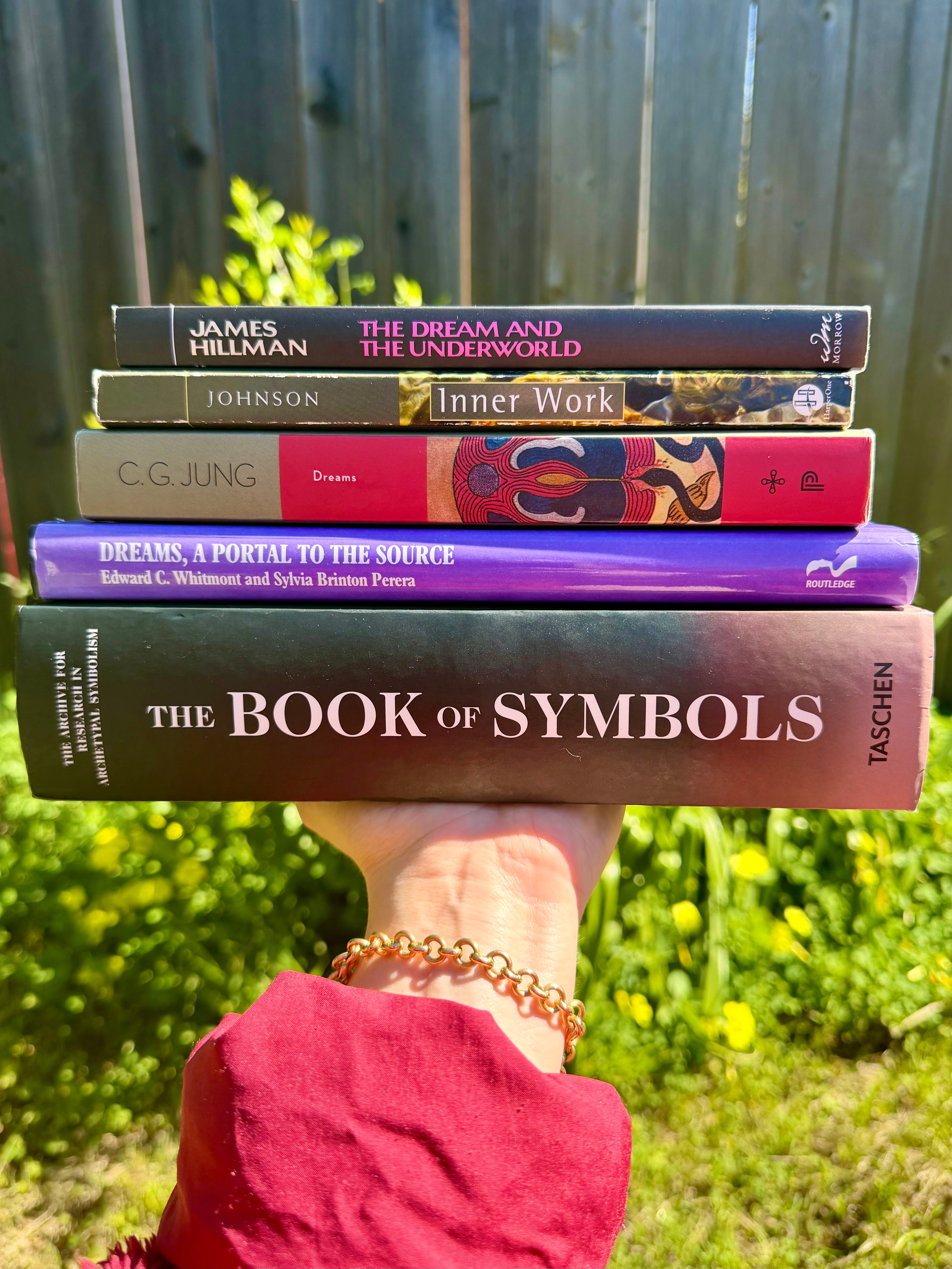
I’ve always been a vivid dreamer. From a young age, the dreamworld bled into ordinary life. Caught somewhere between wakefulness and sleep, images and visions would flood in—sometimes terrifying and overwhelming, other times, wondrous and awe-inspiring. These experiences primed me to be especially receptive and open to the dreaming psyche.
The quality and types of dreams I have vary quite a bit. Often, they’re highly symbolic or mythic in tone, like casting protective magic and interactions with wild animals. Others are incredibly mundane, like a recurring stress dream of being back at my old restaurant job with too many tables to handle. There are times when I dream of others I know, about their lives or some sort of dynamic. These dreams always have a special quality to them, as if the boundaries of reality have melted away and I’ve stepped into their psyche.
As I grew older, I felt the draw to develop my dreamwork skills more intentionally. In my studies and explorations, I naturally stumbled upon Jung’s work, which completely revolutionized my practice. Dreams became the via regia, the royal road to the unconscious, and the main guide for my inner work.
The more I worked with my dreams, the more acquainted I became with the treasure trove of inner symbols teeming within my psyche. I began to notice interesting patterns, like how recurring dream imagery reflected my waking interests and identifications (e.g., sorceresses and wolves). Or, how particular dream themes only shifted after I made meaningful changes or adaptations. The link between consciousness and the unconscious was so much richer than I ever realized. Meeting the dreaming psyche each night has truly been an incredible gift.
If you feel called to work your dreams, this list will be the perfect primer. The books are squarely situated in the Jungian and Archetypal psychology approach, and range in complexity and levels of difficulty, so my hope is you’ll find something to fit your interests.
Alright, let’s dive in!
#1 — Inner Work by Robert A. Johnson


“Once we become sensitive to dreams, we discover that every dynamic in a dream is manifesting itself in some way in our practical lives—in our actions, relationships, decisions, automatic routines, urges, and feelings. We believe ourselves to be in conscious control of these elements of life. But this belief is the great illusion of ego-control. These aspects of our lives are actually determined from a far deeper place. It is in the world of dreaming that their root sources are revealed in a form that we can see and understand.”
— Robert A. Johnson, Inner Work: Using Dreams and Active Imagination for Personal Growth
The first three recommended books are from the classic Jungian school, starting with the most beginner-friendly, and ending in the most advanced. We kick off the list with Robert Johnson’s Inner Work: Using Dreams and Active Imagination for Personal Growth. What sets this book apart from most Jungian texts is its accessibility and simple four-step method for working with dreams.
This is not a common occurrence; most Jungian books tend to stick in the theoretical sphere or are highly academic, geared towards practitioners in the field. As an analyst, Johnson references case history and client work, but it is always presented in a relatable way. Further, his four-step approach offers structure that takes the elusive nature of dreamwork and grounds it in practical action.
The book kicks off with an introduction to the unconscious and its symbolic expressions. Johnson references and defines typical Jungian terms—individuation, ego, archetypes—without losing its accessible tone and language. It is a book clearly written for the everyday individual, an essential resource for anyone embarking on a dreamwork practice.
#2 — Dreams, A Portal to the Source by Edward C. Whitmont & Sylvia Brinton Perera


“As expressions of prerational, ‘altered’ states of consciousness, dreams are as variable as nature itself. Indeed they are a lusus naturae, a play of nature, that can never be fitted into rigid systems. Rather, our rational thought capacity has to learn to adapt itself to the Protean variability of the life processes which dreams represent. Rational or ‘secondary’ thought must learn to adapt itself to the feeling tones and images of the dream, to reflect in reverie and to play intuitively, as seriously as a musician does with a sonata, until meanings emerge.”
— Edward C. Whitmont & Sylvia Brinton Perera, Dreams, A Portal to the Source
A step deeper takes us to Dreams, A Portal to the Source, a collaborative text from two key Jungian analysts, Edward C. Whitmont and Sylvia Brinton Perera. It’s described as “a practical primer for the analyst-in-training.” This might sound intimidating, and though it may be a departure from Johnson’s beginner-friendly Inner Work, I encourage you to give this book a try if you want to immerse yourself in Jungian theoretics.
Though it is designed as a handbook for therapists, you do not need to be one to read this book and find it valuable. Because it systematically moves through the Jungian approach and understanding of the dreamscape, it works as a powerful guide to developing your own dreamwork practice. As a teaching text, it breaks down essential Jungian concepts from compensation and amplification to recognizing mythological motifs and understanding the dramatic structure in dreams.
Some of the material may feel irrelevant (like working with dreams in clinical practice), but consider this perspective as you read through the book: you are both practitioner and client. With inner work, you are the one dreaming and the dream interpreter; you are tasked to record your dream material and have the skills to decode its deeper meanings. Dreams, A Portal to the Source gives you those skills and perspectives.
#3 — Dreams by C.G. Jung


“Since the meaning of most dreams is not in accord with the tendencies of the conscious mind but shows peculiar deviations, we must assume that the unconscious, the matrix of dreams, has an independent function. This is what I call the autonomy of the unconscious. The dream not only fails to obey our will but very often stands in flagrant opposition to our conscious intentions.”
— C.G. Jung, Dreams
Now we enter into the most difficult of the Jungian offerings—an anthology of Jung’s writing on dreams from various volumes of the Collected Works (CW). In all areas of Jungian interest, it is worthwhile to build up to reading him directly. For most of us curious seekers, Jung’s writing comes off as nearly impenetrable—overly dense and exhaustive texts sprinkled with technical jargon, Greek and Latin terms (usually with no definitions)…you get the picture! Keep in mind, these publications were written for the larger medical and scientific community; books designed for the public (like Man and His Symbols) are very different in tone.
Jung’s core writings—the Collected Works—span nearly 60 years. In that time, Jung’s thoughts, concepts, and interests naturally evolved and deepened. Some find that exceedingly frustrating, because in one essay, he will speak of the Self or archetypes in one capacity, and then in another essay, it changes. The same is true for Dreams; this anthology begins with writings from his early career, when he was developing his psychiatric practice and embedded in Freud’s psychoanalytic community.
The later chapters display his psychological refinement and archetypal prowess. Some of them (e.g., “General Aspects of Dream Psychology”) are as straightforward and instructional as it gets for Jung (explorations of different functions of dreams from prospective—how the unconscious images what the psyche is moving towards or anticipating—to compensatory—how dreams offer a complementary perspective that balances the one-sidedness of ego consciousness). I especially enjoyed the final section, “Individual Dream Symbols in Relation to Alchemy”, where alchemical motifs in physicist Wolfgang Pauli’s dreams are examined and interpreted.
#4 — The Dream and the Underworld by James Hillman


“This little book attempts a different view of the dream from those we are used to. Its thesis does not rely on ideas of repression (Freud) or of compensation (Jung), but imagines dreams in relation with soul and soul with death. I have come to believe that the entire procedure of dream interpretation aiming at more consciousness about living is radically wrong. And I mean “wrong” in all its fullness: harmful, twisted, deceptive, inadequate, mistaken, and exegetically insulting to its material, the dream. When we wrong the dream, we wrong the soul, and if the soul has the intimate connection with death that tradition has always supposed, then mistaken dream interpretation deceives our dying.”
— James Hillman, The Dream and the Underworld
Although I am most closely aligned with the classic Jungian school, I often dip into James Hillman’s work and approach, an offshoot called Archetypal psychology. Together, Jung and Hillman provide a broad and expansive exploration into psychological experience. Where Jung sees the psyche as innately attuned to the individuation process—the drive towards wholeness and becoming via the linking of consciousness and the unconscious—Hillman encourages the art of “soul-making,” where we deepen into the imaginal ground of the psyche.
In Hillman’s approach, the monomyth of individuation is cast aside, allowing psyche’s images and archetypal presences to become a revolving door of psychic inspiration that offers new ways of seeing, appreciating, and imagining. His seminal text, The Dream and the Underworld, shakes loose any rigid tendencies to view dreams as compensations or individuation messages. In fact, he mythically situates dreams in the underworld and in death. Doing so means we journey into the dark House of Hades each night, that dreams are an imaging of the soul’s descent.
Hillman further criticizes the knee-jerk interpretative tendencies of many dream workers. When we jump to interpreting the ocean as a symbol of the unconscious or a dream character as a configuration of a power complex, we lose the image and all it has to offer. For Hillman, they are true psychic presences to be engaged and listened to, not symbolic depictions of our psychodynamics or psychological concepts.
Jung and Hillman’s approaches, which may seem contradictory, are profoundly complementary. They naturally broaden and refine one’s approach to the psyche and its inner workings. Though challenging, I think Hillman’s book is an essential read for anyone committed to a depth psychological approach to dreams.
#5 — The Book of Symbols by ARAS


“All of the original essays in this volume are accompanied by images that represent art from around the world and from every era since human beings first depicted, on rocks and cave walls and in simple tools and objects, psyche’s imaginal forms. The same forms appear uniquely in an individual’s dreams and fantasies.”
I am often asked about dream dictionaries or any sort of resource that can help with interpretation of symbols. This is a tricky question because for most individuals, their dreams are composed of images that draw upon their own personal experiences and associations. Reference books, especially mass produced ones, reduce the complexity of dreaming life to simple definitions—most of which are usually wrong or based on stereotypes.
Say you dream often of a peacock. Looking it up on popular websites says it’s a warning about vanity or vague ideas of intuition and protection. These interpretations completely discount the personal layer of dreams. Created through your own inner landscape, dreams are images filled to the brim with your psychic material. The better questions to ask are, “What does the symbol of the peacock bring up for you? What does it remind you of or seem to speak to?”
For one individual, it may bring up a memory of seeing a peacock at the zoo when they were a child, an experience filled with wonder and intrigue. For another, the peacock has always felt odd and otherworldly, its feathers like many staring eyes that bore into the soul. The interpretation of this dream symbol would differ vastly for each of these dreamers.
What a book can do is offer archetypal explorations of dream images, meaning it traces the manifestation of the symbol across time and cultures—from world mythologies, folklore, religion, art, symbolic systems, and more. The Book of Symbols is just that, a mapping of how a particular image bursts from the unconscious and into the collective. Each essay explores these different perspectives, giving you a chance to explore the archetypal richness of psychic images.
In their essay on the peacock, for example, we get excerpts on how early Christian art utilized the peacock as a symbol of resurrection or how the bird was closely associated with the Greek queen of the heavens, Hera. These offerings may or may not hold relevance for your personal dreams, but they are likely to stimulate something within, especially if you’re struggling to understand a dream image or place it in the context of your life.
Dreamwork resources at The Artemisian:
Workshops
Dreamwork Foundations: Introduction & Mapping the Dreamscape
Dreamwork & Divination: A Jungian Approach to Dream Incubation
Articles/Audio Posts
Resource Library
What’s your favorite book on dreamwork?
Have you read any of the books on this list? Which subject should I cover next — let me know your thoughts!
I’d love to know more about premonition dreams, do you have any pointers on where to start with this please?
Hello Alyssa, thank you for your recommendations and the quality of your content. I've been curious whether you'd ever post about your approach to reading these books, I find some of them dense and challenging, full of academic concepts, as you've mentioned yourself. I wonder if there's a different way of approaching them. I appreciate how you teach sitting with the complexity of dense quotes while also breaking down the academic language step by step. Do you have a particular practice or ritual for reading without getting lost in the jargon?