


Inner Work Guides is an educational series that explores Jungian and archetypal topics through a practical lens. Each guide offers insight into core inner work themes, frameworks for personal application, and curated resources. To help keep these offerings accessible and to support The Artemisian, consider upgrading to a paid subscription1.

What unconscious insights can we uncover during heightened emotional experiences?
There is no one path to discovering unconscious material within. Insights and perceptions can be gleaned in a variety of ways, from the images in our dreams to patterns of impulsive behavior or mysterious somatic symptoms. We can also inquire into our shifting emotional states, especially ones that came upon us suddenly: “Where did this intense rage come from? Why am I in tears and feeling so sadly? What brings forth this rush of joy and connection?”
Something deeper brews within the psyche during these times. The temptation to minimize the experience, to sweep it under the rug, or rationalize it away is strong. What if we instead saw these moments as messages emanating from the unconscious?
“Every emotional state produces an alteration of consciousness which Janet called abaissement du niveau mental; that is to say there is a certain narrowing of consciousness and a corresponding strengthening of the unconscious which, particularly in the case of strong affects, is noticeable even to the layman. The tone of the unconscious is heightened, thereby creating a gradient for the unconscious to flow towards the conscious. The conscious then comes under the influence of unconscious instinctual impulses and contents. These are as a rule complexes whose ultimate basis is the archetype, the “instinctual pattern.”
— C.G. Jung, Structure & Dynamics of the Psyche (CW8)
The main takeaways from Jung are:
Heightened emotions cause altered states of consciousness (where ego dims).
The contents of the unconscious intensify and break through the surface.
This reveals structures of the psyche, like complexes, and more deeply, the archetypal foundations they sit upon.
Let’s take a look at this further…
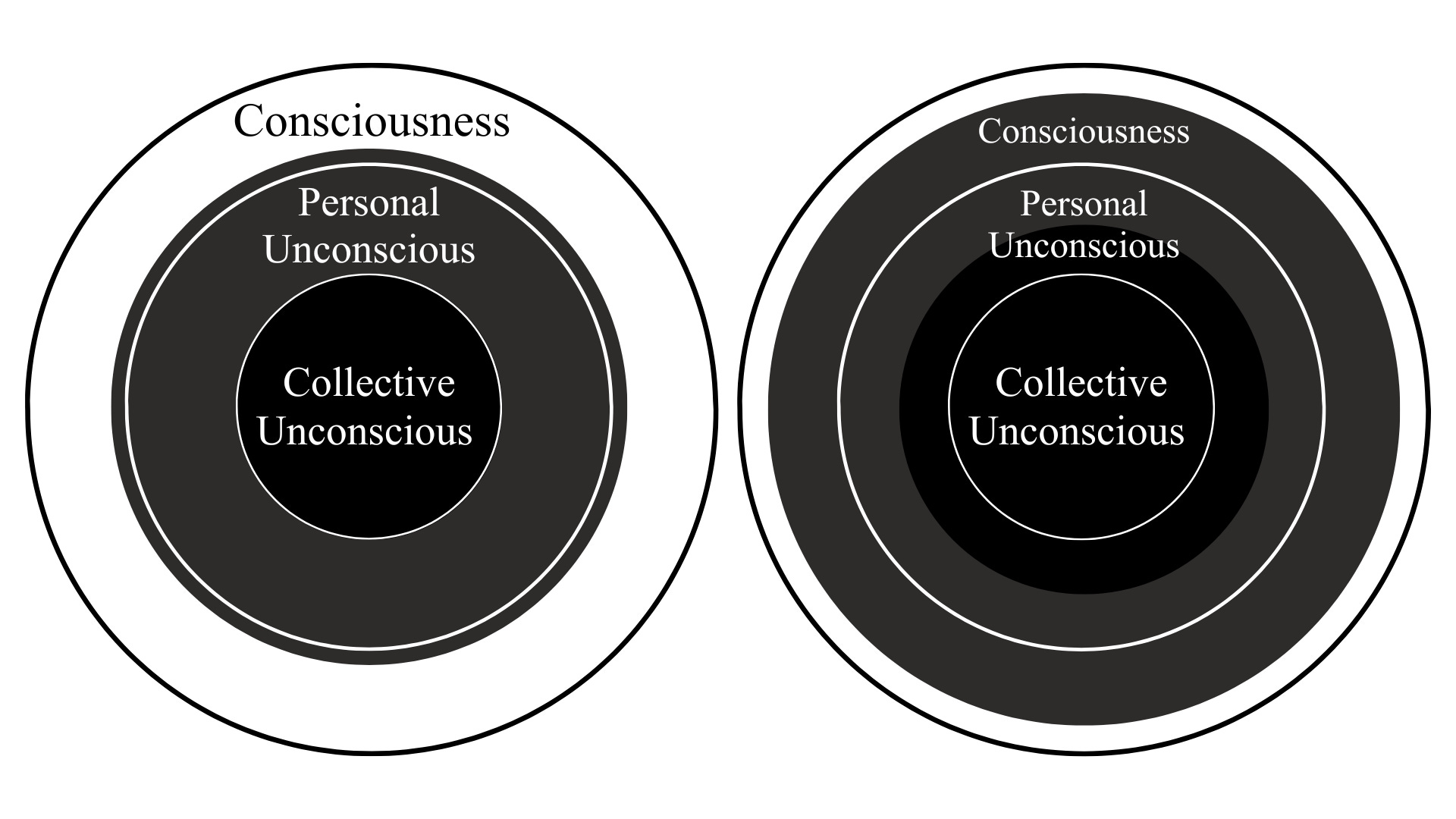
Consider this Jungian diagram2 that depicts the strata of the psyche. On the left side, we see the typical mode of psychic organization. The bright outer ring is the conscious sphere, all the psychic contents that are explicit, obvious, and accessible. It includes the thoughts, memories, images, emotions, and sensations we’re aware of (or can become aware of) in the moment. It also contains the ego, the autobiographical “I,” which provides a sense of identity and continuity.
Beneath this lies the personal unconscious, where complexes, repressed material, and emerging aspects of self reside. Deeper still is the collective unconscious: the universal, inborn layer of the psyche that contains archetypal frameworks, primordial symbols, and psychic drives shared by all of humanity.
During times of psychic disruption, the lower unconscious layers flood into consciousness (see the expansion of the dark unconscious rings in the diagram). As the levee fails, as material from the personal and collective unconscious spills in, we experience a profound sense of disorientation—an altered state of consciousness.
This is a remarkable moment, a piercing into the psychic veil, something that often takes an incredible amount of effort and focus to achieve. Jung tells us that the process is being driven by complexes. Loosely, we can define a complex as clusters of related images, ideas, and experiences held together by a common emotional tone and an archetypal core. They form the basic elements of the personal unconscious, acting as fundamental building blocks of the personality. They are not inherently negative or positive, but range in quality depending on their genesis.
Complexes are sometimes referred to as “splinter psyches3,” which speaks to their semi-autonomous nature and the quality of personhood they carry. They are not a mere emotion or memory exiled away into psychic shadow, they are rich and dynamic, with thoughts, feelings, yearnings, and drives unto themself. Reclamation of a complex strengthens and fleshes out our psychological makeup. It is an essential task of individuation, one that supports a deepening sense of selfhood and wholeness.
This guide is designed to help you meet a complex during times of emotional activation. Doing so illuminates the unconscious in new light, allowing you to access the personal unconscious threads of your inner world, and, perhaps most importantly, the archetypal center that shapes it.
Exploring and Integrating a Complex

“To define the term "complex" briefly, one might say it is an unconscious or half-conscious cluster of representations laden with emotion. A complex consists of a nucleus and a surrounding field of associations.”
— Barbara Hannah, The Inner Journey: Essays on Jungian Psychology
Many of the intractable patterns of behavior, thought, and orientation we find most frustrating are rooted in our complexes. Their autonomy, their capacity to overwhelm consciousness, to subtly or explicitly drive our actions, speaks to their incredible power and influence.
Intention to engage a complex is not enough. Understanding the psychic landscape, all of the surrounding associations, its origins, the role it plays within the psyche, the archetype at its heart — this is what gives us the best chance to truly meet and integrate complex material.
Below are 3 steps and guidelines to support you through this process.
I. — Choose a Situation
Consider a recent time of emotionality. It may encompass a spectrum of possibility such as:
A fit of jealousy that overcame you
An overreaction to being let down that you can’t make sense of
Feeling infatuated by a new individual for reasons you cannot place
A pattern of behavior you find frustrating but cannot seem to overcome
A rigid belief such as, “I’m not good enough”
Anytime you come out of an experience and think, “I was not myself”
Write about the situation briefly.
II. — Elements of the Complex
The next step in the process is to discern the elements of the complex. Try to place yourself back into that state, to recall what it felt like inwardly and outwardly as you explore the landscape of the complex.
The elements of the complex are:
Emotions (the array of feelings present)
Images (mental pictures, symbols, or visual representations)
Thoughts (beliefs, judgements, and ideas)
Memories (recollections of past events)
Physical sensations (noticeable bodily impressions)
Step two often needs to be repeated many times over, especially around compulsive reactions and behaviors we cannot seem to change. Each time we engage in the exercise, we gain more insight. It may take several repetitions to fill out the list completely. With consistency, the general patterns start to reveal itself.
If you use the guide often enough, you can try to do step two when a complex is activated (meaning you are doing so in the moment). This is a task, however, that requires considerable ego stability and nervous system resilience, so you may struggle with the process. The more often you try, the easier it becomes! If you’re not able to catch much during the moment, record as much as you can immediately afterward, when you have come back to yourself.
III. — Reflection and Integration
Once you’ve fleshed out the web of the complex, it’s time to engage in reflection and sketch paths towards integration. Here are some prompts and considerations to help you do so:
Which elements from step two have the most energy and intensity? Try ranking them from most to least activating or intense.
Why do you think one element (such as a feeling of abandonment or an image of a crashing plane) is more powerful than the others?
Can you make any connections back to past events? If so, what happened during that time of your life that may be unresolved?
If the complex were to tell its life story, what would it say?
What purpose or role does this complex serve? How is it trying to support you or compensate for something?
Are there certain qualities, experiences, or aspects of self the complex wants you to claim, acknowledge, or attend to?
What might the complex need to feel resolved, heard, and welcomed?
Based on your reflections, which archetype would you guess sits at the center of this complex?
Lastly, what is 1 - 3 practical actions you can implement based on the insight you’ve gained from the complex?
Here’s an example of this process at work in my life.
I. — Choose a Situation:
A mixup with my scheduling system at work led to a double booking for my clients, with one individual missing their session completely. It wasn’t clear till well after the session concluded what had happened. When I realized it, I felt deeply upset, to a clearly overblown extent. My distress was confusing—sure, it’s important to recognize and learn from my mistakes, but the anguish and guilt I felt seemed to indicate a deeper isue.
II. — Elements of the complex:
Emotions: Remorse, disappointment, guilt, frustration, anger at myself.
Images: Wandering through a dark and chaotic storm.
Thoughts: “I should have caught this.” “It’s my job to foresee these events.” “I failed."
Memories: Times in school when I was unprepared for a group project. Working as a waitress and forgetting orders. Feeling like I letdown someone in my family.
Physical sensations: Tightness in the chest and my body feeling on high alert.
III. — Reflection and Integration
The memories I uncovered in step two really stuck out to me. I was surprised to find myself moving back in time, to past events that seem unrelated, yet clearly have a connection. At the center of these memories is a driving emotional current: a high level of conscientiousness that quickly becomes persecutory. I am not giving myself any grace, no room for mistakes, or to account for factors out of my control. I wonder, “Why do I hold myself to such unrealistic standards?”
I believe the complex is presenting me with an opportunity to develop more compassion, grace, and understanding. I readily offer this to others, often without question. My inability to do so for myself, the resistance I feel, clearly speaks to a tension within.
What role does this persecutor play? On the one hand, it helps me attend to others with incredible attention and care. My ability to anticipate needs, to give freely, and naturally attune to others is one of the gifts of my personality. But it clearly goes too far, my own well being or self-compassion is sacrificed.
The main archetypal pattern that came up for me is The Caretaker. The sense of failure is less about perfectionism and more so about letting other people down. When someone else is involved, there is a heightened need to handle a situation correctly, so that things go smoothly and the needs of others are met. The archetype clearly drives a lot of meaning, but its lacking nuance and balance. I believe this is tied to a learned behavior that began at a very young age.
Practical actions:
When the complex is activated, try to say “this is The Caretaker” to slow down my reactions and build more awareness.
Practice more self-compassion and grace at all times, not just when situations like this come up.
Do a tarot reading with “The Caretaker” as the focus to explore its desires and needs further.
Recommended Resources
Books
“A Review of the Complex Theory” in Structure and Dynamics of the Psyche (CW 8) by C.G. Jung
Complex, Archetype, Symbol in the Psychology of C.G. Jung by Jolande Jacobi
Chapter 2, “The Populated Interior” in Jung’s Map of the Soul by Murray Stein
At The Artemisian
Mythic Inner Work (workshop)
The Inner Fire: Erupting Forces of Psychological Renewal (article)
Join the conversation
Do you have any thoughts or questions on complexes? Have you used other techniques to navigate and work with complexes in your life? What main complex are you grappling with currently?
And enjoy all the benefits that the membership has to offer. More info here!
Adapted from Consciousness and the Unconscious: Lectures Delivered at ETH Zurich, Volume 2: 1934 by C.G. Jung.
“Today we can take it as moderately certain that complexes are in fact “splinter psyches.” The aetiology of their origin is frequently a so-called trauma, an emotional shock or some such thing, that splits off a bit of the psyche. Certainly one of the commonest causes is a moral conflict, which ultimately derives from the apparent impossibility of affirming the whole of one’s nature.” — C.G. Jung, Structure & Dynamics of the Psyche (CW 8)
The framing of emotional activation as a 'piercing into the psychic veil' rather than something to manage or suppress is such a crucial reorientation. So much of modern wellness culture treats strong affect as a problem to solve rather than a message to receive. What strikes me most about this guide is how it honors the autonomy of complexes — the idea that they carry 'a quality of personhood' — without pathologizing them. That distinction between reclamation and elimination feels essential. Integration isn't about conquering the splinter psyche; it's about giving it a seat at the table. This series is a real gift for anyone doing depth work outside the therapy room.
Thanks for sharing the personal anecdote. The clarity of the process is very helpful, like undergoing therapy. Identifying an archetype might take some time though, wonder if there're any tips.